MindfulZone


MindfulZone
Using latest technology aims to support students with attention deficit hyperactivity disorder (ADHD)
Classroom
Lam Chun Wai Milton, Chen Lianyu Lucas, Chan Sheung Hang Alwin
2026
Global goals

Our project, MindfulZone, aims to support students with attention deficit hyperactivity disorder (ADHD). Characterizing hyperactivity, impulsiveness, and inattention, these symptoms might lead to poor academic performance, impaired social skills, anxiety, and communication challenges. The Hospital Authority reported about 21,300 diagnosed ADHD patients in public hospitals in 2022 to 2023. ADHD diagnoses increased significantly from 2011 to 2020, with rising cases of ADHD, hyperactivity and inattention, creating growing challenges for educators and social workers.To address these challenges, we developed MindfulZone, which consists of two parts: Breathing Space and Tai Chi Corner. Breathing Space is an immersive exercise that trains slow ‘Ha’ breathing at 4.5 breaths per minute. This technique helps slow the body, release emotions, and improve focus and confidence. Tai Chi Corner allows users to practice Tai Chi movements within a virtual environment, promoting gentle movement, enhancing focus, and encouraging mindfulness through guided exercises.In this project, we utilized a VR headset, controllers, and Breathing Sensing Belt, which incorporates a Loadcell weight sensor, micro:bit, belt, and Lego bricks. MindfulZone was developed using XRCC, a code-free platform with integrated VR support. XRCC utilizes block-based visual programming, making it accessible for creating interactive scenes. In Breathing Space, we tried three versions – flex sensor version, fan sensor version and the weight sensor version. Flex sensors can detect force applied to the float noodles but cannot directly track the breathing motion. Fan sensors can measure airflow, but it is difficult to mount it on user's head. After several prototypes, we chose the weight sensor as the final solution because it is easy to use and provides accurate measurements. During the breathing exercise, users breathe to make two hemispheres match in size. The Breathing Sensor Belt detects abdominal pressure changes: inhalation increases the sensor reading as the belly expands, and exhalation decreases the reading as the belly flattens. As users inhale, the top hemisphere expands; as they exhale, it contracts. The background turns green for satisfactory performance and blue if performance is unsatisfactory. The system prompts users to repeat the breathing cycle three times. After the exercise, users select how they feel, receive one reward card, and see their score displayed on screen, along with a button that directs them to the Tai Chi Corner
ADHD diagnoses increased significantly from 2011 to 2020, with rising cases of ADHD, hyperactivity and inattention, creating growing challenges for educators and social workers.
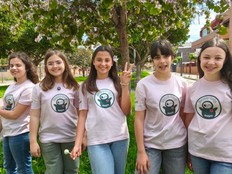
Helpie is a companion robot specially designed for hospitalized children. Its main function is to reduce the stress and anxiety that hospitals produce through stories, songs, and fun visuals.
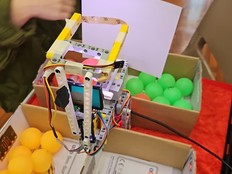
An AI machine that automatically identify fruit quality → classify → stratified sales → reduce labor costs, increase income.
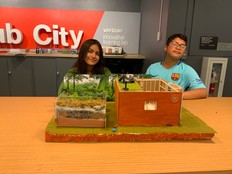
This project uses micro:bits to simulate wind power, control lights, and monitor humidity in an evapotranspiration toilet.