Why human skills matter more than ever in the age of AI
As AI reshapes education and learning, Tom Doust explores why human creativity is becoming more important than ever.
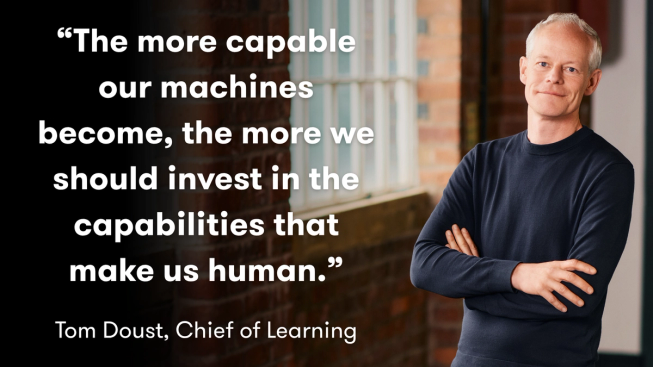
Tom Doust, Chief of Learning at the Micro:bit Educational Foundation, shares his perspective on why human skills matter more than ever in the age of AI.
When the BBC micro:bit launched over ten years ago, it was against a backdrop of ‘computer science for all’. Back in 2016, some technologists declared that ‘coders were the new rockstars’. Computer science educators embarked on coding and digital literacy campaigns in schools across the world, recognising that young people needed the skills to thrive in an increasingly digital society. But when the micro:bit launched, it also carried a different message. Computing wasn't just about programming computers. It was about giving young people the opportunity to create, build and make with technology.
Through physical computing with the micro:bit, children weren't simply learning to code. They were inventing, experimenting and bringing their own ideas to life.
Fast forward ten years and the conversation has shifted again. Today, we hear calls of ‘AI for all’. Artificial intelligence continues to dominate headlines with predictions of large scale disruption and profound changes to the way we work, live and learn. Education policy makers are rushing to make AI literacy frameworks accessible to global education systems. International institutions, like the OECD, have recently made recommendations for primary and secondary education to support schools to prepare children and young people for what is being termed the ‘Age of AI’.
It is essential that every young person understands how AI works, not only to question and critically challenge it, but to think about the ethics of AI and how we use it responsibly. But are we at risk of missing something even more significant? As AI becomes increasingly capable of generating code and designing software, we risk a generation of young AI users outsourcing a unique human faculty that distinguishes us from every other species on the planet: imagination. The future won't belong to the people who can simply use AI tools. It will belong to those who can imagine new possibilities with AI by asking intelligent questions, thinking creatively and critically and using technology to help solve meaningful problems.
In the Age of AI, the ability to imagine unconventional ideas, navigate ambiguity and evaluate meaning becomes the defining advantage for humanity (OECD).
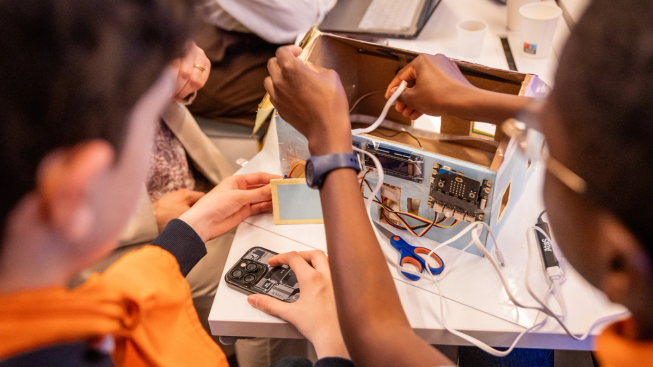
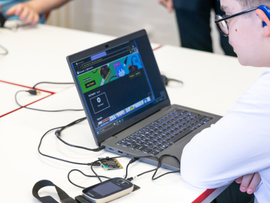
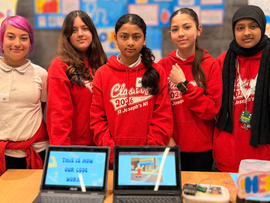
Young people collaborate, experiment and bring their ideas to life through hands-on physical computing with the BBC micro:bit.
This changes the way we should think about education. If education becomes focused solely on consuming AI generated content, we risk creating passive users of technology rather than active creators. Young people may become increasingly proficient at asking machines for answers, but less confident in developing their own ideas, testing their own hypotheses and assessing the quality of answers from machines.
Education and learning has historically been about acquiring knowledge. Much of this approach is surprisingly still at the forefront of many curriculums. But as AI encroaches and disrupts how we teach and learn, the holistic skills that come with being curious or a critical thinker, are now more important than ever. Building confidence and a sense of agency that one can amplify with technology is crucial if we are to ensure that children can build their best digital future.
This is why making with physical computing still matters. When a young person builds a project with a micro:bit, they quickly discover that technology is not magic. It requires exploration and experimentation. Ideas don’t always work the first time. Things need adjusting. Code still needs debugging. Design ideas evolve through iteration, trial and error and prototyping. These are learning experiences through which creativity and wider skills can develop.
The same principles apply to AI. When learners move beyond simply interacting with AI and instead explore how, for example, machine learning systems are trained or how data shapes decisions, they develop something far more valuable than technical knowledge. They develop a deeper understanding and become curious and capable of questioning how technology is made and used, thinking of ways in which it could be reshaped.
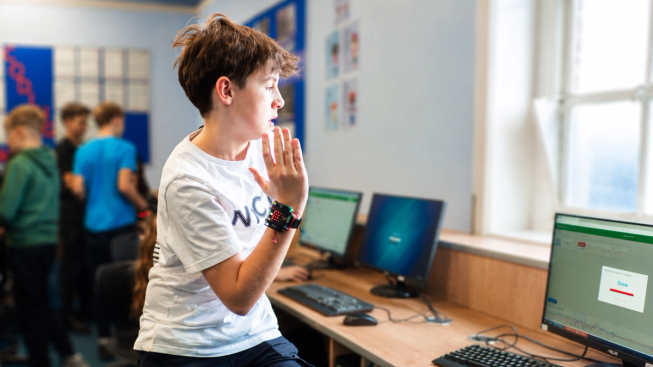
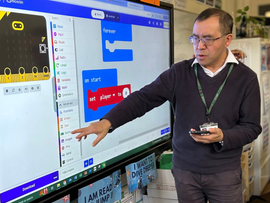
Physical computing helps young people explore technology through movement, experimentation and creative problem-solving, building confidence alongside technical skills.
Physical computing is especially powerful because it brings learners’ ideas to life, making them tangible and present in the real world. With micro:bit CreateAI, machine learning data is no longer something hidden, its live data being captured, locally and privately, by the movement in the micro:bit’s accelerometer. This data can then support learners to understand how it influences behaviour, how systems respond and how their own ideas can shape future outcomes.
This is why the micro:bit remains as relevant today as it was a decade ago. Its purpose has never been to teach programming for programming's sake. It exists to help young people realise that technology is something they can shape. Perhaps this is the biggest lesson in this new AI age? The more capable our machines become, the more we should invest in the capabilities that make us human: imagination, curiosity, creativity, empathy and good ethical judgement. AI can generate content in seconds. But how good is it at deciding which problems are worth solving, what matters to a community or why one idea is more meaningful than another? For now, those remain profoundly human questions.