Skip to content

Cell City

Cell City

Subcellular structures transformed into a Real, Live City.

doyourbit.xyz

Euginia, Malik and Shawna, Alessandra Balajadia, Yousuf Ahmad Khan, Saad Saqib, Daniil Semenyaka, and Nour Sadek, Alma Maklad, Jasmine Grace Ndungu, Vihaan Vig, and Kevin Jose Nunez Perez, Shanaya Jadav, Malek Tarek Mohamed, and Oginya Farouk

2025

Global goals

SDG 11 Sustainable Cities and Communities

Our project

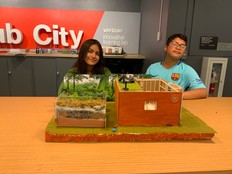
Cell City transforms subcellular biology into a real, explorable metropolis. Every organelle becomes a building, district, or transport system, and just like a real cell, each part must operate and cooperate for the city to thrive. It’s part science translation, part systems-thinking sandbox, and part immersive world. The microbit was used to demonstrate the workings of the Mitochondria, which produce energy, the centrioles, and the nucleus.

Our inspiration

The NIS Scholars wanted to make real-life connections. They wanted to see and experience what they were learning, not just memorize diagrams. A project that showed interdependence—how many small parts have to cooperate for a big system to work

You may also be interested in

Students sit in front of laptops and their prototype of the soil moisture detector.

Soil Moisture Detector

United Arab Emirates

Using soli moisture sensors to detect dry soils and potential for fires.

Students pose with their Evapotranspiration Project prototype.

This project uses micro:bits to simulate wind power, control lights, and monitor humidity in an evapotranspiration toilet.